
Turning logistics providers from passive warehouse reporters into inventory strategists - built on CargoWise's API, discovery to delivery in a quarter.
Context
About the platform
Helps support Logistics Service Providers and their customers. The platform provides a unified view of the supply chain, delivering a simple tracking and management experience to both the users, and their customers.
Why inventory management?
Simply put, before and after goods are shipped, they need to be stored, organized, and prepared for fulfillment. Warehousing bridges the gap between when products arrive at facilities and when they're ready to move toward their final destination.
The LSPs Role
LSPs handle inventory management because it's more cost-effective for companies to outsource warehousing and distribution to specialists than to build and maintain their own complex supply chain operations.
A Day in the Life of a Logistics Service Provider
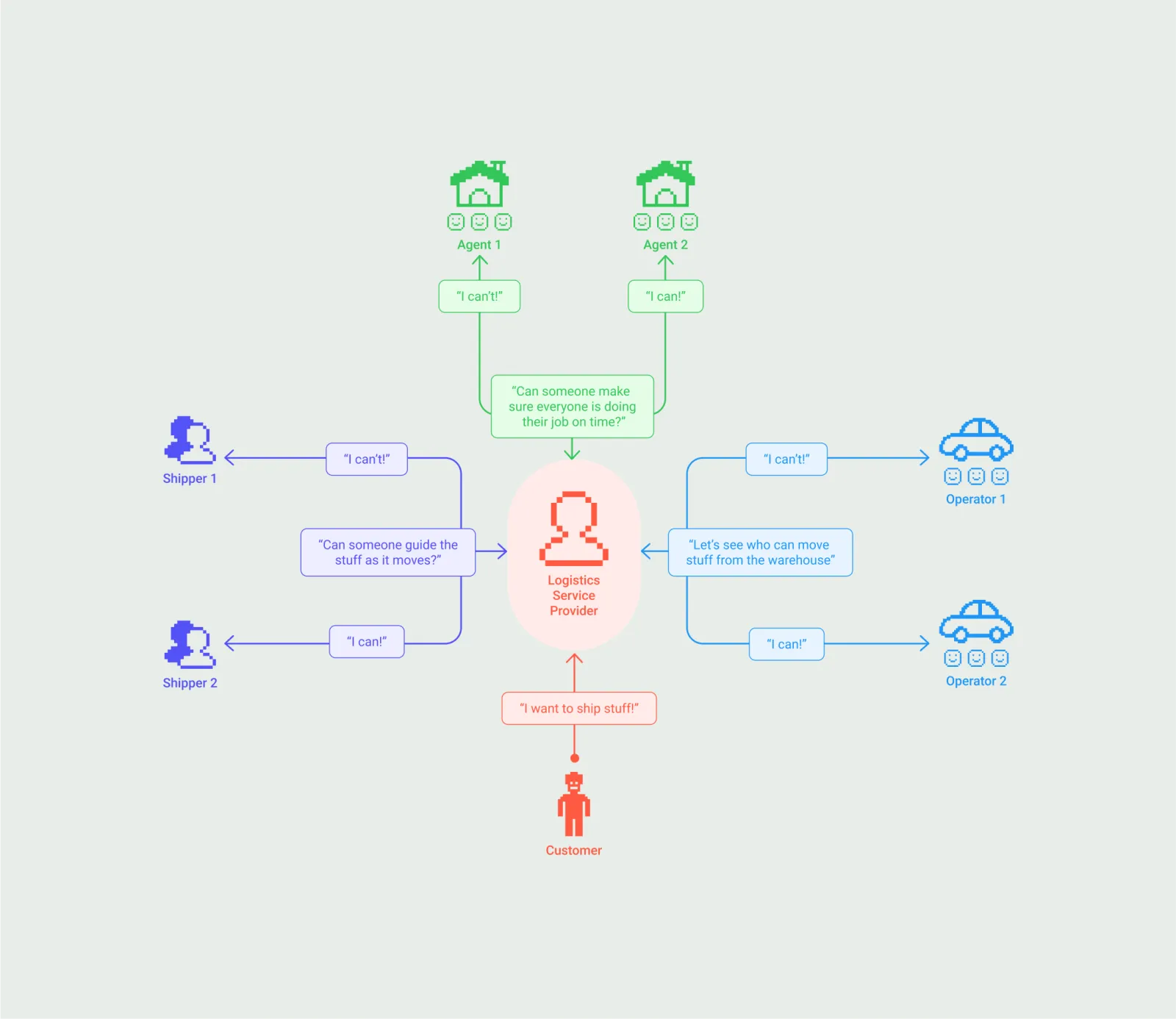
As the main point of contact for customers, port workers, warehouse managers, and more, LSPs and their teams spend their days mired in phone calls, emails and messages. Coordination is their main job, and it is tedious due to lagging adoption of technology in the supply chain industry.
 (view larger)
MVP Scope
Goals
CargoWise, the transportation management system of choice, has a robust API that delivers large swaths of data.
Working with PM and internal SMEs, I identified how CargoWise’s mandatory data fields and information would flow into LogixBoard’s interface.
01 Module Cohesion
Solve warehousing-specific needs and integrate seamlessly with existing shipment modules and workflows.
02 Inventory Clarity
Surface the right data at the right time without overwhelming the user.
03 Integrations
Leverage data from TMSs within inventory module, and write back to keep the source of truth up to date.
Milestone 01: Monitoring Inventory
Inventory Monitoring
The integration with CargoWise gave us the data we needed to get level-monitoring functionality up and running quickly.
Key Aspects
Warehouse Summary: Shows a concatenated view of all products at a warehouse and focused on inventory levels.
Warehouse Details: Focused on showing individual products at each warehouse, making it easier to understand product levels, expiration, etc.
Product Details
With the help of the integration, we imported orders and receipts related to the product, stock levels, and tracking incoming/outgoing activity.
Key Aspects
Everything is accessible directly from the product details page with the help of slide out drawers
Documents can be viewed and downloaded
Other products on the receipt or order can be accessed directly from the slide out drawers
Milestone 02: Orders
Placing Orders
Having inventory levels of a warehouse made placing orders easy - we designed and shipped a simple workflow that let inventory owners move their goods as and when they needed.
Key Aspects
Orders originate from warehouses, as is reflected in the first step.
This provides a list of products available to order from the warehouse.
Search capabilities and a “cart preview” feature to increase ease of use of long available product lists.
Supporting documents can be easily attached to an order.
Monitoring Orders
With the ability to place orders, we also added an index to monitor order statuses.
Key Aspects
Shows all orders inclusive of those created within LogixBoard as well as the integrated transportation management system.
Filtering by status.
Ability to view individual orders and the products within the order.
Ability to view product details from the order details page.
Results and next steps
MVP Release
LSPs managing inventory through manual processes or basic TMS solutions were the target users.
🚀
Real-time inventory monitoring
🚀
Integrated order and receipt management
🚀
Orders and receipt monitoring for live warehouse movements
Next Steps
Early adopters gave us plenty to pursue for Inventory Management.
I transitioned from LogixBoard before efforts on next steps could begin.
Cross-module integrations
Users needed better connections between warehousing and existing LogixBoard features, particularly automatic shipment creation from warehouse orders.
Advanced Analytics
Early adopters requested predictive capabilities including reorder point recommendations and seasonal trend analysis to move from reactive to proactive inventory management.
Multi-location management
Customers with multiple warehouse locations needed comparative analytics and transfer management between facilities.
 (view larger)
Reflections
01
Running two back-to-back 0 → 1 → 2 in 6 months was something I did not know I could run!
Working as the sole designer with PM and engineering partners, I successfully extended LogixBoard's platform into entirely new territory while maintaining the design quality and user experience standards the platform was known for.
Bookings →02
Translating complex freight forwarding domain knowledge into intuitive software design, integrating CargoWise's technical requirements, and establishing the foundation for LogixBoard's comprehensive supply chain vision - all within a tight 3-month timeline - demonstrated the power of systematic design process execution.
03
A vision is extremely grounding and sets up for success. The customer research insights gathered post-launch provided clear direction for advanced warehousing capabilities, setting the stage for LogixBoard's continued evolution toward then CEO, Julian Alvarez's vision of a “single pane of glass” for freight forwarding operations.